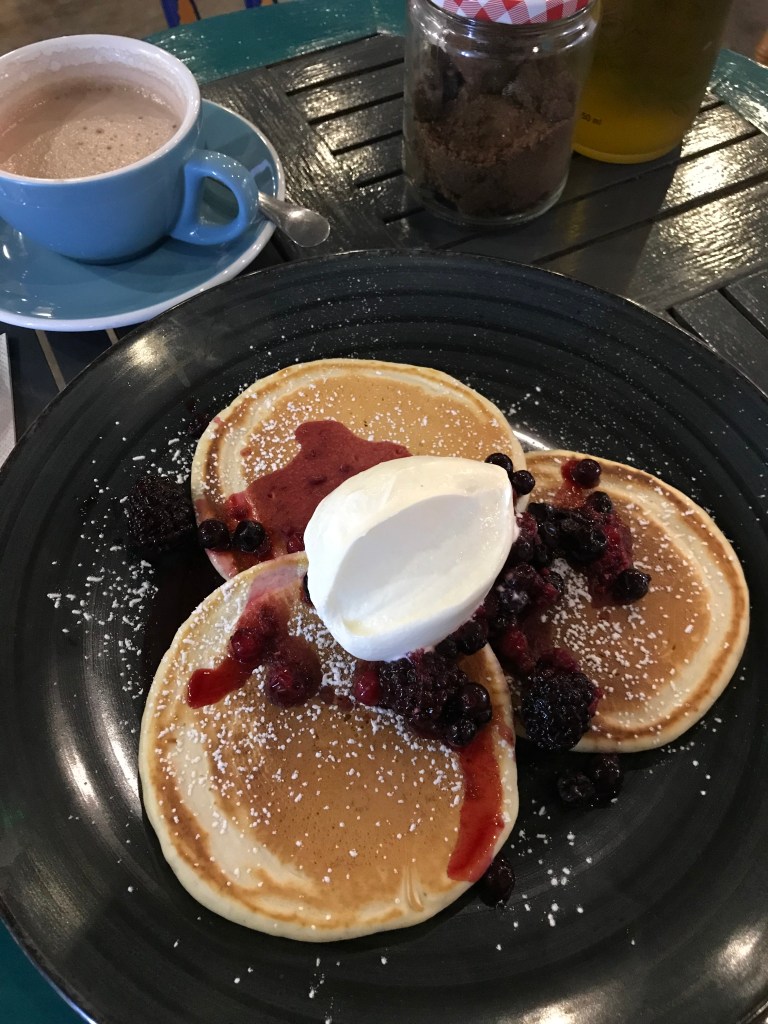
As you can imagine, part of the experience of being abroad is learning all about and becoming immersed in a new culture. American culture, however, is everywhere (which, is both a positive and negative aspect of American culture — a whole other conversation) and thus I’ve had some opportunities to view aspects of American culture through a Spanish lens.
As such, everything in this post has something to do with American culture but with a little Spanish flair!
American Food
In the middle of the city there’s a department store called Corte Ingles that is basically a hybrid of IKEA, Target, and Kohl’s. Plus, on the first floor of the store, there’s a grocery store (like a King Soopers / Kroger) and a gourmet foods store. The gourmet foods store is very fancy, selling everything from fancy cheese to expensive chocolate to vintage wines.
They also have international food sections, carrying fancy yet typical food items from countries like Japan, Mexico, and Britain.
They also have a section for the United States.
Before I give you the list of what foods are included, let me preface it with this: these are the foods that are thought by Spaniards to be typically American, foods that Americans consume as part of their daily diet.
Here’s the list:
- Marshmallows
- Oats (the kind you would use to make oatmeal cookies)
- Candy canes
- Jelly beans
- Pop Tarts
- Pancake mix
- Crisco (yes, the shortening)
- Chocolate chips
- Marshmallow fluff (because one type of marshmallow isn’t enough apparently)
- Peanut butter
It’s some list, isn’t it? It was very eye-opening me, to say the least. Very crazy to think that this is the representation of American food here!
Making chocolate chip cookies
Once my host mom found out that I like to bake, she asked if I would like to bake something, so of course I said yes!
But then there was the problem of what to make. I eventually settled on simple chocolate chip cookies — who knew simple chocolate chip cookies could cause such an interesting experience?
The first thing I quickly realized was that my American chocolate chip cookie recipe (thank you, Food Network) used American baking measurements (cups, tablespoons) while here they use grams. So, I scrounged the Internet for a conversion website and, upon finding one, had to convert all of the recipe’s measurements.
Math is not my forte. It was a struggle.
Secondly, when my host mom first had approached me with the opportunity to bake something, I had been under the impression that I would be doing the baking, and she would be watching me and helping if needed. This was not the case.
A typical Spanish mother (and grandmother), Carmen took control of the baking, while I stood on the sidelines and called out the ingredients. When it came time for the mixing, she plopped everything into her electric blender/mixer and turned it on for 30 seconds, max. A lot less time than I would have mixed the batter for, but I wasn’t about to butt in and argue with her ways in the kitchen.
A third complication arose when Carmen told me that she hadn’t been able to find chocolate chips at her local grocery store (apparently, they are only available at Corte Ingles), so instead she bought chocolate covered peanuts. Not exactly the same thing, but a call to my own grandma assured me that they wouldn’t entirely ruin the cookie.
After we put them in the oven, Carmen told me that once the timer went off, we would stick a knife in the cookies to see if they were done. Now, I am aware of the knife baking technique, but it’s not something we normally use for cookies. Once again, however, I wasn’t going to go up against Carmen and her techniques.
Because we waited until the knife came out clean, the cookies were in the oven a lot longer than I would have liked. (The bottoms ended up being burnt.)
Finally, while Carmen ran to the store to go get something, I ate two of the cookies while they were still warm, because who doesn’t love a warm cookie? Despite the burnt bottoms and the peanuts being a little roasted, the cookies were still delicious. When Carmen got back from the store, however, she asked me if I had already eaten two of the cookies. I said yes and she shook her head.
Apparently, eating warm cookies is not something Spaniards do.
Overall, the whole cookie-making experience was a whirlwind. I learned a lot about how differently baking is approached here than in the United States. A lot of it is simply just different, but I’m sticking by my own culture’s affinity for warm cookies. No matter what anyone says, warm cookies are simply the best.
West Side Story
As some of you theatre lovers might have deduced, the title of this post is from the musical West Side Story (specifically the song “America”).
I had the amazing opportunity to see West Side Story here in Alicante at the Teatro Principal. The musical, the original Broadway version, is currently on tour in Spain. They’ve completely translated the show into Spanish — both songs and dialogue — so that audiences here can enjoy it!
Apart from the show being absolutely fantastic, it was very cool to see not only the differences between American theatre and that of Spain, but also the differences within the show itself (granted, I have never seen an American professional performance of West Side Story, but I’ve seen several other professional American musicals and know the storyline of WSS well enough to be able to notice these differences).
Here are some of my thoughts/insights:
- The theater itself was smaller (but older) than its American counterparts.
- The programs were very different that those of the United States. There were no headshots, no advertisements, no extra readings, no act/song lists. They simply had the names of the actors, the names of the writers/producers/crew, and what events were upcoming at the theater.
- With a show that deals with racial tensions and the contrast between Hispanics and white people, having the entire show be in Spanish (for me personally) takes some of the intensity out of the show’s central conflicts. It’s not quite as impactful to have a Jet scream, “Get out of our country,” but in Spanish.
- The PDA in the show was definitely more than what would typically be seen in an American musical. I’m pretty sure this is a cultural addition. Spanish culture is much more touchy and uninhibited when dealing with things like sex, so when the musical was adapted for Spanish audiences, I’m sure the interactions between the characters were changed to fit this culture. (Plus, all of the actors were Spanish, so they’re bringing in their own culture into their acting as well.)
- Finally, how the lyrics were translated from English to Spanish was fascinating. Obviously, the notes and the rhythm of the songs cannot change, so a translator must find a way to fit the new language into the preexisting song. From what I observed, this can be done in two ways. First, what the characters actually sing can be changed, so that the new words fit into the song. For example, in “America,” the varying reasons that Anita gives supporting America’s greatness in the Spanish version are different than those in the original. These lyrics have been completely changed so that the Spanish can fit the melody of the song. Second, a lyric might need to be worded a little differently in order to fit, thus changing its meaning slightly. For example, in “Tonight,” instead of singing “tonight, tonight,” the Spanish characters sang “Por fin, mi amor.” Por fin, mi amor translates to “Finally, my love.” So instead of singing about what is happening tonight, the characters sing about what is finally happening. There’s a slight change in the song’s meaning here and it’s utterly fascinating to me (a nerdy English major).
I might have gotten a little carried away with the language lesson there (sorry!), but I hope more than anything you’ll come away from this post having learned a little about how cultures can cross paths, and about how sometimes small (yet intriguing) differences can arise from these interactions.
¡Hasta luego!
— Grace

 Where in the World Is Grace Elizabeth?
It’s always very strange to see your own culture portrayed by another culture. Even as a Canadian living in the USA, it’s often funny to see how strangely we’re portrayed by our own closest neighbours.
LikeLike